
Tetrapods

starting at €90.00

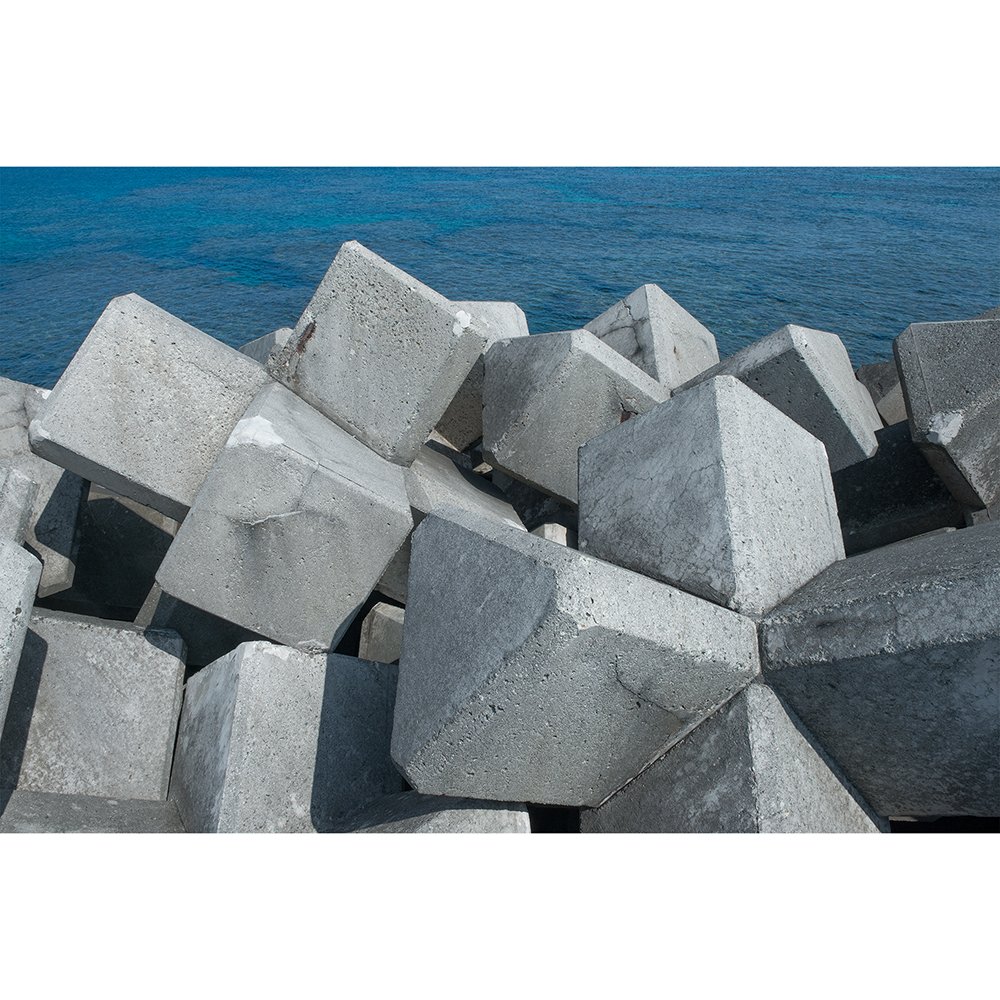
We are not talking about four-legged vertebrates here, but concrete breakwater blocks. Developed in France, these "concrete horns" are practically an institution in Japan. They come in round, triangular, square, and hexagonal shapes, with diameters ranging from one to five meters. Apparently, up to half of Japan's 35,000-kilometer coastline is lined with tetrapods! These specimens represent the Okinoerabushima strain.

Product:
Size:

We are not talking about four-legged vertebrates here, but concrete breakwater blocks. Developed in France, these "concrete horns" are practically an institution in Japan. They come in round, triangular, square, and hexagonal shapes, with diameters ranging from one to five meters. Apparently, up to half of Japan's 35,000-kilometer coastline is lined with tetrapods! These specimens represent the Okinoerabushima strain.

CONCRETE DECAY – the antidote to beauty clichés

The Science Term Bank defines beauty as an aesthetic quality that is generally considered a type of aesthetic value. According to the philosopher Plato, beauty is a true reality that can be understood by reason, but whose imperfect reflections can also be perceived by the senses. Aristotle, on the other hand, defended the principle of purposefulness. The opposite of these views is that beauty is a purely subjective value, i.e., beauty is in the eye of the beholder. Also ugliness is in the eye of the beholder. Decadent romanticism, the beauty of ugliness, is an ideological movement that emerged in the late 18th century. According to this movement, an object can be perceived as beautiful simply because looking at it gives pleasure.